
Draconic Chart
A draconic chart is a version of your birth chart in which the zodiac is measured from the Moon’s North Node instead of the spring equinox: the node becomes 0° Aries, and every planet shifts by the same amount. Enter birth date, local time, the UTC offset in force then, and latitude/longitude manually. The calculator estimates Sun through Neptune, Ascendant, MC and the North Node, compares both charts and prints a wheel. It does not look up cities, time zones, Pluto or house cusps.
- Free to use
- No sign-up
- Runs in your browser
Quick answer
A draconic chart moves every planet in your natal chart back by the zodiac longitude of the Moon’s North Node, so the node lands at 0° Aries. Example: with the North Node at 15° Leo (135°), a natal Sun at 10° Scorpio (220°) becomes 220° − 135° = 85°, which is 25° Gemini in the draconic chart. Enter your birth date, local time, UTC offset and coordinates below to estimate the supported positions. City and time-zone lookup, Pluto and house cusps are not included.
Draconic chart calculator
Astrology Chart Printables
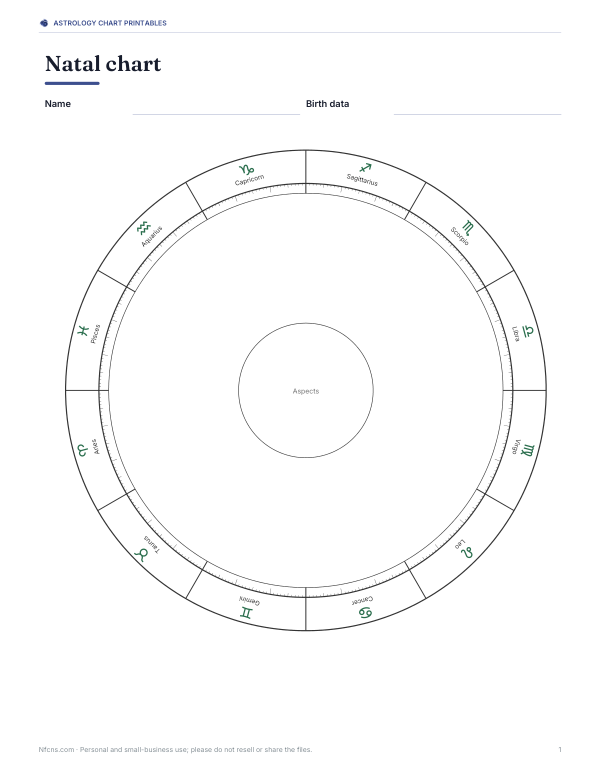
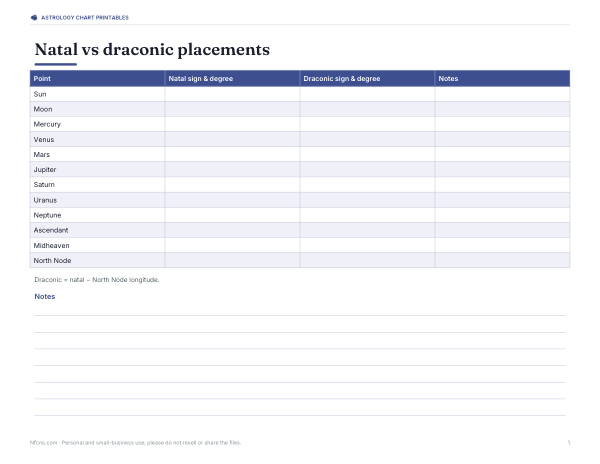
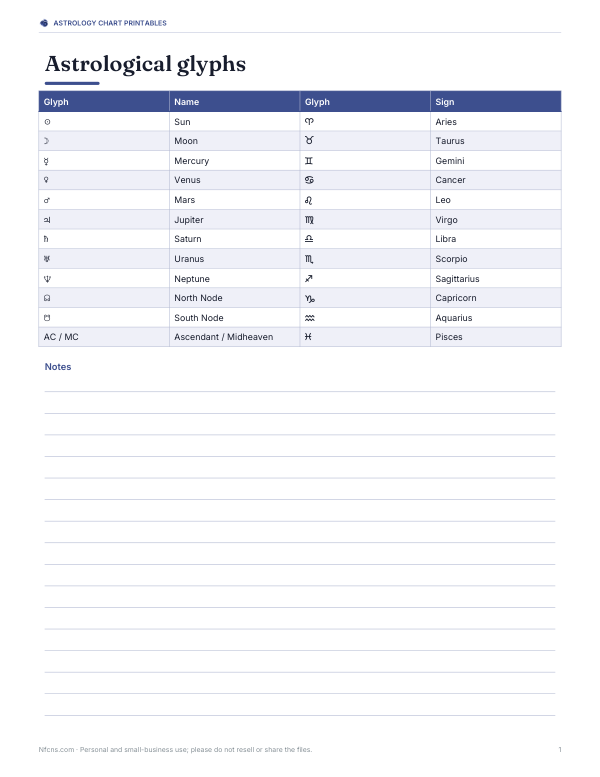
Three printable PDFs (4 pages) with blank natal and draconic wheels, a comparison worksheet and a glyph reference. All PDFs are free individually; the $5 ZIP adds an editable Excel comparison table for manual entry.
- Blank natal and draconic wheels: 2 pages (PDF)
- Manual comparison worksheet (PDF/XLSX, no calculation formulas)
- Glyph reference: 1 page (PDF)
Formats: PDF, XLSX. Instant download after payment (link valid 72 hours, up to 5 downloads). AI-assisted: the templates were drafted with AI help and reviewed and laid out before publishing.
$5.00 USD, one-time 4 resource files + README (5 files total)
- Instant download
- 7-day refund
- Secure checkout by Stripe
7-day money-back guarantee. Full refund within 7 days of purchase, even after you download.
Full refund within 7 days — see the refund policy and license.
Free printables
Single sheets you can print right now, no sign-up. The full pack adds every sheet in one download plus the editable files.
What is a draconic chart?
In Western astrology the ordinary (tropical) zodiac starts at 0° Aries, where the Sun crosses the celestial equator in spring. A draconic chart instead starts the zodiac at the Moon’s North Node — the point where the Moon’s orbit crosses the ecliptic heading north. The node is placed at 0° Aries and every planet, angle and point moves by the same amount, so all the relationships (aspects and house placements) stay the same; only the signs change. Astrologers who use it often describe it as a chart of underlying motivation or “soul” themes.
How the calculation works
- Convert the birth time to Universal Time using the UTC offset in force at the time.
- Calculate the tropical longitudes of the Sun, Moon and planets, and the Ascendant and Midheaven from the birthplace.
- Calculate the Moon’s North Node — mean (a smooth average) or true (including its wobble).
- Subtract the node’s longitude from every point.
- Read the new signs: the node is 0° Aries; a planet 30° past the node is at 0° Taurus, and so on.
Worked example
If the North Node at birth is at 12° Aquarius (312° of the zodiac) and the Sun is at 24° Gemini (84°), the draconic Sun is 84 − 312 = −228°, which is 132° — 12° Leo. Every other point moves back by the same 312°. Aspects don’t change: if the Sun and Moon were 90° apart in the natal chart, they are still 90° apart in the draconic chart.
Mean node or true node?
| Mean node | True node | |
|---|---|---|
| What it is | The average position of the node | The actual position, including short-term oscillation |
| Motion | Always backwards, steadily | Mostly backwards, sometimes briefly forwards |
| Difference | — | Up to about 1.5° from the mean |
| Effect on the draconic chart | Slightly different degrees | Occasionally a different sign near cusps |
Both are used. Choose the one your astrologer or tradition uses, and note it on printed charts.
Birth data tips
- Use the exact birth time if you have it — the Moon moves about half a degree an hour, and the Ascendant about a degree every four minutes.
- Enter the UTC offset that applied at the time, including daylight saving time.
- Latitude and longitude of the birthplace matter for the Ascendant and Midheaven, not for the planets.
- If the birth time is unknown, ignore the Ascendant, MC and exact Moon degree.
Reading the table
The table lists each point’s natal (tropical) position and its draconic position. Because the shift is the same for every point, the draconic wheel looks like the natal wheel rotated. Many people compare the two — for example, noting when a draconic planet falls on a natal planet or angle.
The lunar nodes explained
The Moon’s orbit is tilted about 5° to the Sun’s apparent path (the ecliptic), so it crosses the ecliptic at two points each month. The North (ascending) Node is where the Moon crosses heading north; the South Node is exactly opposite. The nodes slowly move backwards through the zodiac, completing a full circle in about 18.6 years. Eclipses happen when a new or full moon occurs near a node — which is why the nodes were important to ancient astronomers, and the source of the old name “draconic”, from the dragon once said to swallow the Sun or Moon.
How much the chart shifts
Because the node moves about 19° a year backwards through the zodiac, the size of the draconic shift depends on your birth year. People born about 18.6 years apart have similar node positions and therefore similar draconic shifts, while people born nine years apart have nodes roughly opposite each other. The draconic shift is the same for everyone born on the same day, but the Ascendant and Midheaven still depend on the time and place.
Draconic charts and other variants
| Chart | Zodiac starts at |
|---|---|
| Tropical (natal) | Spring equinox point |
| Sidereal | A fixed star reference (depends on the ayanamsa chosen) |
| Draconic | The Moon’s North Node |
| Heliocentric | Positions as seen from the Sun |
Accuracy
The calculator uses astronomical approximations in your browser and accepts dates from 1800 through 2050, latitudes from 66° south to 66° north, longitudes from -180° to +180°, and UTC offsets from -14 to +14 hours. These are input limits, not a numerical accuracy guarantee. Compare important positions with an independent ephemeris. Unsupported polar locations are rejected rather than replaced.
A note on astrology
Astrology is a cultural and interpretive tradition, not a science; this page describes how draconic charts are calculated and used within it. The positions themselves are astronomical calculations.
Astrology printables
All 3 PDFs are free individually. The $5 ZIP adds an editable Excel comparison table with no calculation formulas. Enter positions manually; the pack does not generate charts or personalized interpretations.
AI-assisted content
This page was drafted with AI assistance and reviewed before publishing.
Frequently asked questions
How do you calculate a draconic chart?
Subtract the natal North Node longitude from each supported point and wrap the result to 0–360°. The node becomes 0° Aries. This calculator estimates Sun through Neptune, ASC and MC; it does not calculate house cusps or Pluto.
What is a draconic chart?
A birth chart measured from the Moon’s North Node, which is set to 0° Aries.
How do you calculate a draconic chart?
Subtract the North Node’s longitude from every planet and point.
Do aspects change in a draconic chart?
No, all angles between points stay the same.
Should I use the mean or true node?
Either is used; the difference is up to about 1.5°.
Do I need my birth time?
Yes: birth time affects the estimated Moon position, Ascendant and MC. An unknown time cannot produce reliable angles.
Is my birth data uploaded?
No, everything is calculated in your browser.
How often does the North Node change sign?
About every 18 months, moving backwards through the zodiac.